


Many chemical elements owe their names to geographical locations. Their discoverers sought to immortalize their homeland or country in the periodic table. There we have francium, germanium, polonium, americium, europium, and californium… But surely no place in the world has received as much honor as the Swedish village of Ytterby, which has given its name to no less than four elements—ytterbium, terbium, erbium, and yttrium—and has also been the source of the discovery of the rest of the lanthanides, as well as scandium. This is its story.

 In 1788, Swedish army lieutenant Carl Axel Arrhenius, a chemist and mineralogist (not to be confused with the famous Svante Arrhenius), was stationed in the Stockholm archipelago when he visited the small island of Resarö (just 4 km long and now home to fewer than 2,400 inhabitants). There, in a feldspar mine near the town of Ytterby, he came across a strange black stone previously unknown to mineralogy…
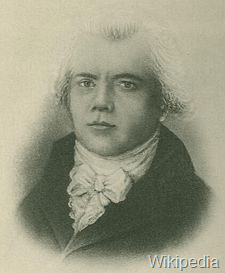 The specimen (or another of the same mineral) reached the hands of Finnish chemist and mineralogist Johann Gadolin, who, in 1794, analyzed it and discovered that it contained something new. (In recognition of his discovery, the mineral was later named gadolinite.) Later, other researchers concluded that this «something new,» which they called yttria (from Ytterby), was actually a mixture of oxides.
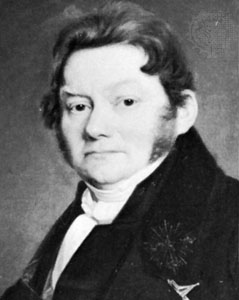 At the same time, Swedish chemist Jöns Jacob Berzelius and others were investigating another new mineral, cerite, and found within it ceria, which also turned out to be a mixture of oxides. As a result, the initial simple conclusion that the pure oxides of two new chemical elements (yttrium and cerium) had been discovered had to be revised.
Ceria
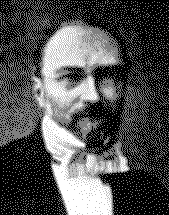
One of the scientists who did so was Carl Gustaf Mosander, who can be considered more than just a disciple of Berzelius—he was his “scientific son,” as he even lived under the same roof as Berzelius and his wife for a time. Mosander greatly unraveled the complexity of the yttria and ceria oxides.
 He began working with ceria, from which, in 1841, he managed to isolate an oxide that was present in small proportions. He named it lanthana (from the Greek λανθανεῖν, meaning «hidden») and called the new chemical element it contained lanthanum—which indeed turned out to be a new element.
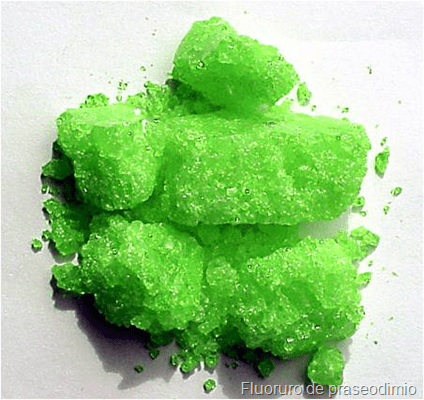
Later, he separated another oxide from ceria, didymia (from the Greek word for «twin»), believing it contained the element “didymium.” However, 44 years later, it was proven that didymium actually consisted of two elements. In 1885, Baron Carl Auer von Welsbach confirmed suspicions that had emerged years earlier through spectroscopic analysis: didymium was a mixture of two oxides—praseodymia (“green didymium” in Greek) and neodymia (“new didymium”), from which he was able to isolate the elements praseodymium and neodymium.

It is worth noting that Von Welsbach, besides being a chemist, was also an inventor. One of his most successful creations was the incandescent mantle, a fabric impregnated with thorium, cerium, beryllium, and magnesium nitrates that greatly increased the brightness of gas lamps, allowing 19th-century city streets to be properly illuminated. The Germans named the baron’s incandescent lamp “Auerlicht.”
Yttria
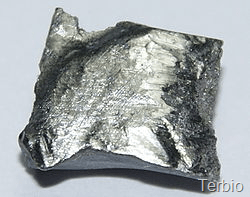
But let’s return to Mosander. In 1844, while working with yttria extracted from gadolinite, he found it to be an exceptionally complex oxide. In addition to yttrium oxide, he observed that natural yttria samples contained cerium oxide (ceria), didymium oxide (didymia), lanthanum oxide (lanthana), and—most importantly—two previously unknown oxides: a yellow one, which he named erbia, and a pink one, which he called terbia. (Interestingly, the names of these two were later swapped.) As expected, both names were derived from the Ytterby mine.
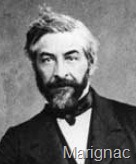 Three decades later, in 1878, Swiss chemist Jean Charles Galissard de Marignac heated erbium nitrate obtained from gadolinite until it decomposed, then extracted the product with water. He obtained not only the already-known erbia (erbium oxide) but also a new oxide, which he named ytterbia. The same scientist spectroscopically discovered gadolinium in 1880, naming it in honor of Johann Gadolin, the «father» of this entire genealogy of rare earths. Then, in 1907, Georges Urbain found a new oxide in a sample of ytterbia, which he named lutecia in honor of his birthplace, Paris, the ancient Roman Lutetia Parisiorum.
More Rare Earths
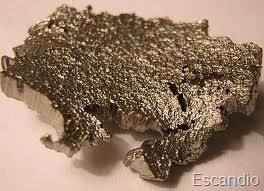
The chain of discoveries sparked by the black stone that Lieutenant Arrhenius found in the Ytterby mine did not end there. In 1879, chemist Lars Nilson identified another oxide within erbia, which he named scandia, in homage to Scandinavia, the peninsula where Sweden, his homeland, is located. Within scandia was, naturally, scandium.
That same year, Swedish chemist Per Theodor Cleve (already famous for having spectroscopically discovered that Marignac’s «didymium» was actually a mixture of two elements, as Von Welsbach later confirmed) managed to isolate two more oxides from erbia: holmia and thulia. The first contained holmium (which had previously been identified via atomic spectroscopy), and the second, thulium. The name «holmium» comes from Stockholm, Cleve’s hometown, while «thulium» is derived from Thule, an ancient name for Scandinavia.
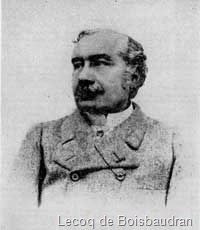 In 1879, French chemist Paul Émile Lecoq de Boisbaudran found samaria (samarium oxide) in a sample of didymia. This was a new rare earth element, named after its primary source, the mineral samarskite, which, in turn, was named after Russian Colonel Vasili Samarsky-Bykhovets, a mining engineer. Thus, he became the first person to have a chemical element named after him—later, there would be other eponymous elements, such as einsteinium, curium, and nobelium.
In 1886, the same Lecoq de Boisbaudran obtained gadolinia, an oxide of the same gadolinium that Marignac had spectroscopically identified in 1880, as previously mentioned. That same year, he successfully separated dysprosia (the oxide of what would become the new element dysprosium) from a sample of holmia. (Incidentally, Lecoq de Boisbaudran also discovered gallium in a zinc ore sample from the Pyrenees. He named it in honor of his country, but some skeptics at the time claimed he actually named it after himself, as his surname, Lecoq, means «the rooster» (gallus in Latin). He even had to publish an article denying the claim.)
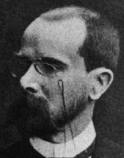 The prolific chemical lineage born in Ytterby has one of its latest members in europium, discovered in 1901 by Eugène-Anatole Demarçay. Through a laborious fractionation process of samarium and magnesium nitrate, he isolated europium oxide. Demarçay lost an eye in an explosion during one of his experiments, but this did not dampen his famously excellent humor.
To complete this genealogy, we must add the last lanthanide: promethium, initially called illinium (Il). However, its discovery story is rather convoluted…

